

The SCOTUS Tariff Ruling: Why the Battle for Free Trade is Just Beginning

Updated: Feb 23

The SCOTUS Tariff Ruling: Why the Battle for Free Trade is Just Beginning
How the Administration is Pivoting to New Statutes After a Major Legal Defeat
The U.S. Supreme Court has delivered a significant blow to executive overreach in international trade. By striking down global tariffs imposed under emergency powers, the Court has reasserted that the power to tax remains with Congress. However, as the Dow surges 200 points in response to the news, a new era of trade uncertainty is already unfolding.
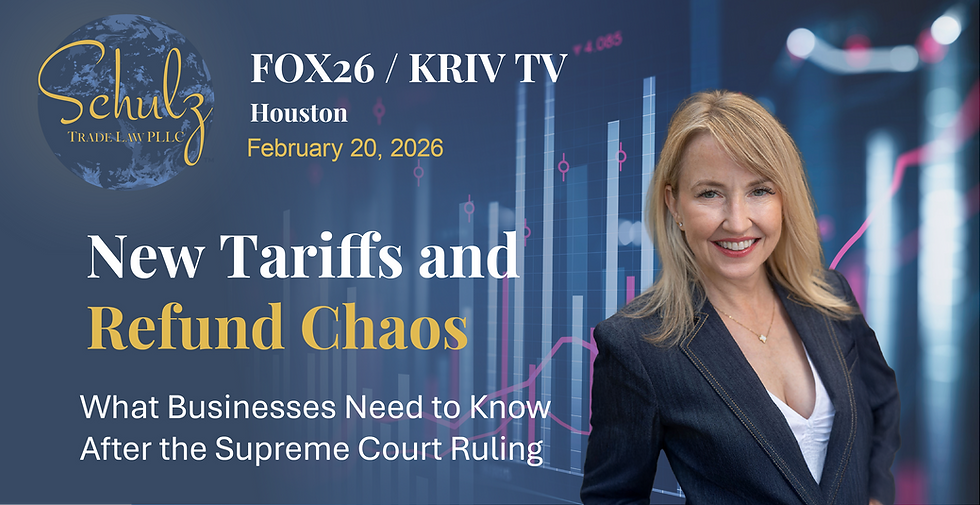
International trade attorney Michelle Schulz joined KNX Radio and Fox 5 New York to explain why importers should temper their celebrations with strategic preparation.

The Constitutional Rejection of IEEPA
The nation’s highest court ruled that the administration broke federal laws by claiming emergency powers under the 1977 International Emergency Economic Powers Act (IEEPA). The ruling clarified that the President cannot unilaterally levy reciprocal taxes on nearly every trading partner without Congressional approval.
"The justices in the majority found that the Constitution very clearly gives Congress the power to impose taxes." — Antwan Lewis, Reporting on the SCOTUS Decision
The New Arsenal: Section 232 and Section 301
Despite the ruling, the administration is vowing to use "other avenues" to keep tariffs in place. This includes a pivot to alternative federal statutes that do not require an emergency declaration but still allow for significant trade barriers:
Section 232 (Trade Expansion Act of 1962): Used to justify an across-the-board 10% tariff on goods based on national security.
Section 301 (Trade Act of 1974): Allows for investigations into "unfair trade practices," which could lead to additional, targeted tariffs.
"The President can legally impose tariffs under different laws even if businesses would rather not see that happen." — Michelle Schulz
Importer Frustration and the "Complex" Path to Refunds
While the SCOTUS decision offers hope for reclaiming past payments, Michelle Schulz warns that the refund process for IEEPA-related tariffs will be "complex and nuanced". Many importers remain frustrated, as they continue to face penalties for non-payment while navigating a system that may soon be hit with a fresh wave of secondary tariffs.
"There may be refunds available on these IEEPA tariffs, but importers should keep in mind that that could take a very long time." — Michelle Schulz

Is Your Business Prepared for the Next Wave?
The "emergency" may be over, but the era of high tariffs is simply changing shape. Whether you are seeking a refund for previous IEEPA payments or need to prepare for upcoming Section 301 investigations, expert legal counsel is essential.
Schulz Trade Law is currently assisting clients in navigating these new statutory hurdles. Contact us today.
Trade on, but trade informed!
Subscribe to Schulz Trade Law for more updates.


Comments